
SirBillybob
-
Posts
3,942 -
Joined
-
Last visited
Content Type
Forums
Donations
News
Events
Gallery
Everything posted by SirBillybob
-
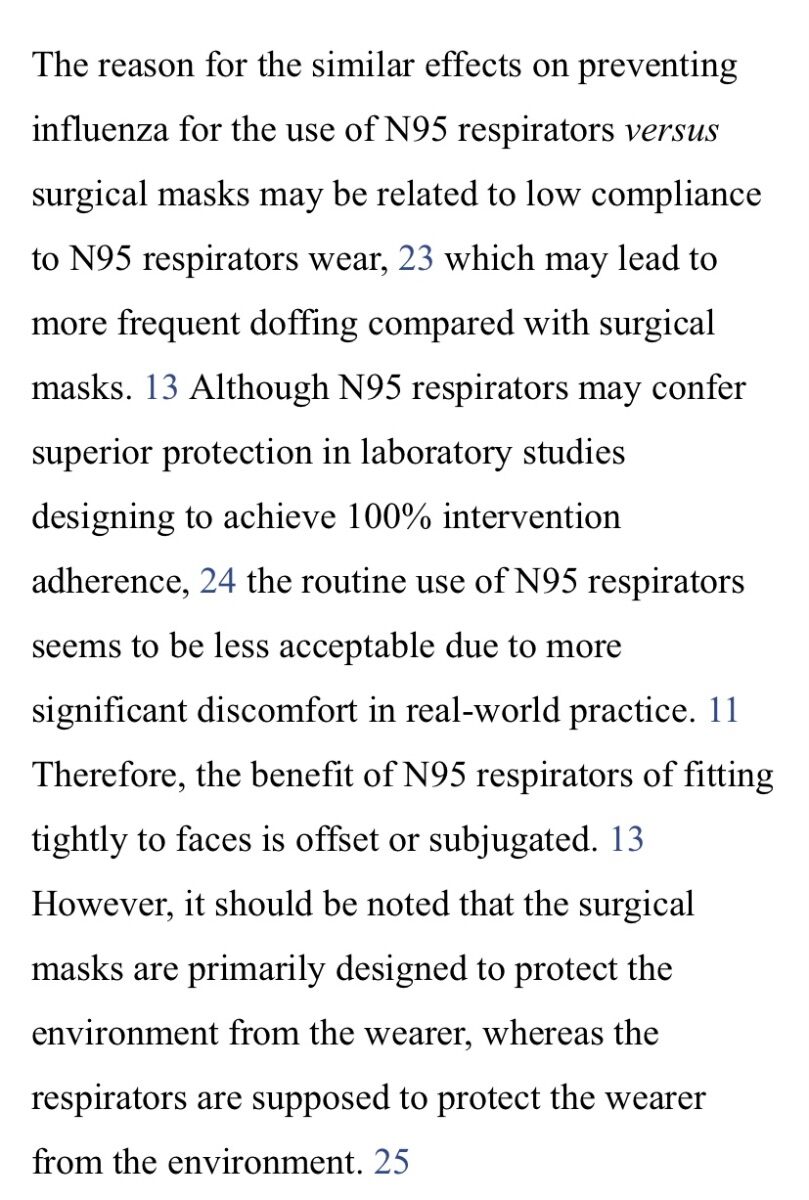
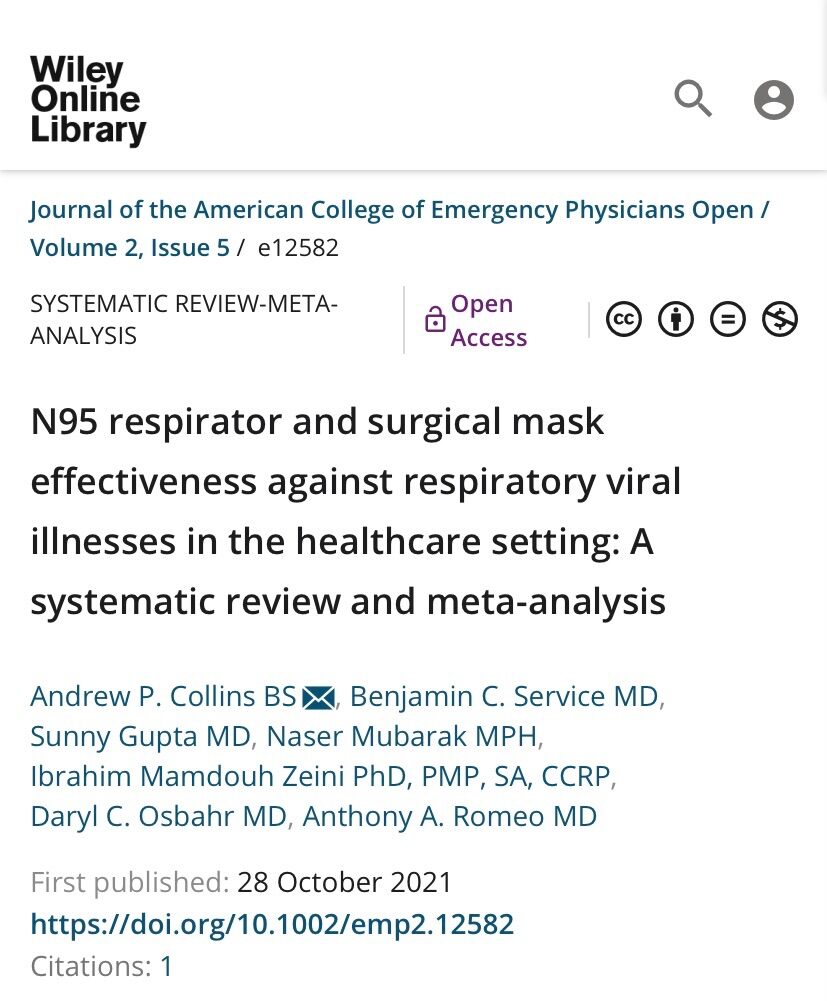
Thanks for posting the link. As such, anybody here can read the full article Discussion and pick up that that the researchers are not dismissive of case-control methodolology that nevertheless downgrades it, relative to RCT, within the level of evidence hierarchy. In fact, many of the limitations are posed by the complexities of bias that affect that RTC gold standard for studies of this nature. Breadth of relative risk metric for the CoV component, albeit case-control methods, fleshes out the story. In spite of the elaborate cogent outline of limitations, a portion of which you selectively quoted, a large part of the Discussion strongly underscores the differential value of respirators in terms of infection risk receptivity. If you remove the CoV component, you are left with findings more reflective of the RCT grouping that were imported into the recommendation of respirators, in spite of no apparent effects for confirmed flu. Similarly, if you exclude confirmed flu, the remaining findings buttress the idea of respirator advantage, notwithstanding the research list’s minority proportion of non-RCT. This way of looking at the findings is analogous to meta-analytical data sensitivity analysis. A strongly persuasive totality of findings discounting respirator superiority did not emerge in this meta-analysis. One of the references is a meta-analysis exclusively RCT-inclusive and has a different angle, more summarily dismissive of a difference between surgical and respirator, yet presents limitations that undermine the evidence certainty. (See below) In sum, it would be easier to switch to surgical. I take all the input with a grain of salt, but a combination of behavioural habituation, and the limited extent of research findings in the direction polarized from where I think the balance rests, leaves me ‘team N95’. I am not suggesting absence of evidence is not evidence of absence. I did not intuit a preference. Rather, the evidentiary tilt at this point influences my choice. [Anyway, this is me OUT, off-grid this topic for now, heading to Spain with my travel declaration etc all completed, and better things ahead than a basically high-output low-impact board discussion such as this.] https://www.ncbi.nlm.nih.gov/pmc/articles/PMC7228345/

-
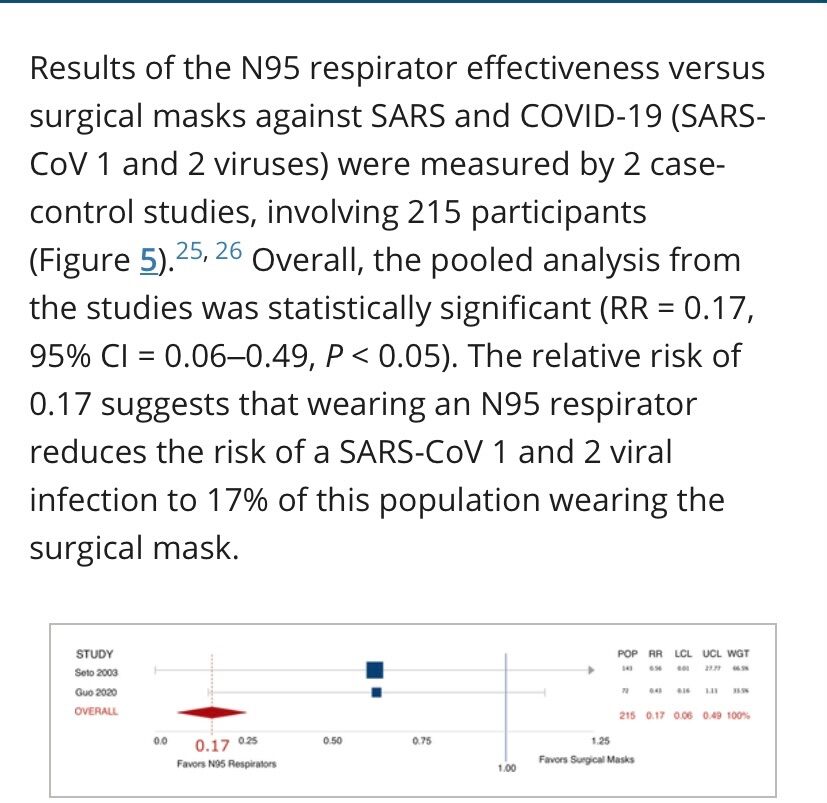
I spotted one human (non-medical-engineering particle-focused example) I append here, simply from a quick Google search on my tiny screen. It seems more pronounced and happens to collapse two SARSes, as well as limited to a meta-analytic blend of but two studies that itself prohibits sensitivity analysis, but I am not trying to cherry-pick because these reports as a whole generally concede low certainty evidence irrespective of findings. That low certainty applies to either side of an arbitrary binary of any hypothesis or corresponding null. I don’t use a computer or tablet any more so I try to limit eye strain. I have read a few systematic mask comparator reviews but I don’t keep formal track because I am long retired and my ID Grand Rounds presentation days are considerably behind me, as is reference hoarding previously necessitated by manuscript &c critical appraisal role. You may relate because I believe you have repeatedly cited one particular 6-study meta-analysis on the board. These studies I have tripped upon include COVID proxy examples, some where applicable extrapolation is reasonably warranted, others that subsume CoV-specific components in the methodology. In fact, I believe that the meta-analysis you cited (China-specific? Wuhan ancestral?) may be dated enough to be no more representative than other respiratory proxies, considering marked contagion and lethality changes since then. The net takeaway from my sporadic reading is that, notwithstanding research limitations posed by both individual and meta-analytical approaches, a properly worn respirator confers an edge. As but one component within an aggregate of mitigation measures it falls short of absolute irrelevance. I agree that respirator quality lives on a gradient. I already pointed out that the knowledge translation does not suggest a strong argument for public recommendation. However, preferential use of a respirator reflects neither a characterological contrarian trait nor an overriding of the limited extant research. —— I meant the two screenshots to be reversed in order.
-
There is more than one systematic review of mask typology in the context of SARS-CoV-2, as well as meta-analytical research in relation to comparative effectiveness for influenza and related respiratory illness, research stated as partially intended to cross over into the CoV realm. Respirators/N95s are consistently non-inferior to surgical/medical masks; that is incontrovertible. Data sensitivity analysis by researchers suggests superiority of respirators in some ways; not the reverse. Those findings have tended to be downplayed by the researchers themselves (a report bias) due to HCW supply issues earlier in the pandemic, and by assumed real-world behavioural compliance problems in proper use owing to greater physical discomfort posed by respirators that may offset any protective advantage. Therefore, like Wachtel (?) I use N95s in indoor settings and usually nothing outdoors. However, what is common between the two of us is access, affordability, and I imagine the willingness to trade off comfort for what is likely a marginal advantage considering the moderate degree of protection conferred by either format in the first place. As such, I see no point in broadly recommending one over the other for the masses. Science and practicality go hand in hand. Admittedly, this year so far I wore N95s in crowded sauna brothel common areas with extremely high background infection prevalence on approximately 30 occasions, and where 95% of fellow occupants wore no face coverings. I should probably have acquired infection even though dodging karaoke crooners belting out songs off-key. Repeated RATs and RT-PCRs supported the reality of not having caught SARS-CoV-2. I don’t know that mask use or type made the difference. The clinical heuristic suggests it did. I caught a bad but non-hemorrhagic case of dengue fever in urban Brazil a few years ago, a holiday ruined. The morbidity risks are elevated with catching any subsequent subtype. It was statistically rare but I probably undertake anti-skeeter protection no less inconvenient over the years there than is the hassle of a mask. Same goes for on-demand PrEP with condom use when there.
-
I highly recommend DK Eyewitness Travel for Switzerland and it’s avail online, eg iBooks, if not hard print (I have both). You can easily do Basel, Lucerne, and St Gallen separately on same day regional train trips return. Each of these is ridiculously walkable once there, as is Zürich for the most part. Both the main central station and the airport station are part of the regional rail network and, beyond machine sales, have helpful real-person wicket agents that double as tourism guides. The airport regional train counter also helped me figure out city tram passes for 2 consecutive 6-day periods (due to my location requiring daily tram usage). I bought a tailored fare package that included airport train fare both ways and 12 days of tram. I did not subsequently need to fiddle at all with any fare machines taking credit cards. You machine-stamp the light-cardboard tram card first thing each day you use it (if you buy a multiple-day fare). I never encountered a tram attendant checking it. In contrast, all regional train tickets were checked and punched by a roaming attendant. I typically don’t bother using integrated travel/venue cards for Zürich. I had already previously seen most pay establishments. The main station similarly has a large integrated tourism and train ticket sale room in the central hall. It is popular and busy; you may have to wait about 15 minutes after pulling a queue number ticket, but purchasing and orienting then goes fast. Trains anywhere are extremely regular, once or twice per hour. The main art museums in Zürich and Basel are stellar. The toy museum in Basel is fun. St Gallen has a famous Abbey and quaint centre, all UNESCO World Heritage. I found the Rosengarten art museum in Lucerne as worthwhile and interesting as that city’s main Kuntsmuseum adjacent to the train station. If you do a lake boat cruise and were to choose between Lucerne and Zürich I would opt for Lucerne for greater mountain-surround, although you would be extending your day visit. Take seriously the advice to arrive at the airport 4 hours ahead, unless perhaps you have queue priority. My international gates both ways also required considerable walking and a high-speed train shuttle. Mind you, I was flying Swiss; that might render check-in volume greater. I estimate the line-up on a weekday late morning was 90 minutes for many. With 4 hours I had time for a brief lunch and about 30 minutes to spare from initial boarding call. Hope you have a great holiday. There is probably little else you don’t already know or can’t figure out, but feel free to ask.
-
Here’s another go at a post I just deleted: I believe there are models that can assess how much “from” and “with” get baked into each other, accounting for the degree to which they may otherwise be conflated due to clinically more proximal conditions and other factors. I believe it involves estimates of happenstance of active infection across expected all-cause mortality and across similar but infection-free illness, with constancy in historical mortality denominators enabling calculations of the changing ratio of “from” : “with” as estimates of rolling new infection incidence and case fatality change.
-
[delete; changed my mind]
-
In Montreal less selection of dancers by specific club, particularly weekdays, but close proximity among the venues augments selection via bar-hopping. Everything in one place, so to speak, and a good launching point for any sightseeing. The greater regularity of functioning nights also promotes more consistent options of an evening almost any evening. Hotter is subjective so I won’t put forward my impressions there. There is usually a trade-off between cities. In Montreal the clubs are bars first and foremost, no gouging no “visa” charge by the house related to entry into the private dance aspect. You can tune into live streaming for Stock Bar for a partial sense of what is on offer. Some dancers perform elsewhere because while they may prefer to be with particular friends (peers) they don’t all have the same comfort for greater public exposure.
-

Montreal strip clubs are back in full swing
+ SirBillybob replied to Sydneysider's topic in Male Strip Clubs
Sounds like an answer drawn from the sex trade handbook, but you were also here recently, so ... In some cases what is actually ambiguous has the flavour of clarity. I think it’s a fair and well-intentioned response, perhaps even grounded in a visit. However, I have lived here for 20 years, and in my experience whether fellatio occurs in a private lap dance is decoupled from cash amounts negotiated or paid. Because it is a different take I should elaborate rather than simply contradict. So, for those with the right attention spans: Almost any time fellatio occurred it had not been discussed ahead of time. The only stipulation is that no lap dance will commence that does not culminate in the [ahem] client’s orgasm; that is something framed as the prospective inevitable outcome of the dancer’s appeal, not an expectation. Let me also categorically say that I am certain there is nothing special or advanced about my capacity to get what I want from dancers and I am always basically one down. But feel free to specifically ask the dancer. The single time I inquired the baseline quote was $900; a straight physique model dabbling in solo porn. He knew I was not a cop; at the time it was a criminal offence to communicate about transactions, and this discussion was in a public venue. This is obviously an outlier and not meant to illustrate the trend of response, so I don’t know if there is or should be an upsell these days and I do not engage on that level even recently, as indicated. He obviously does not like to do it but was able to get that amount with clients here and in NYC sorted by wealth and by potential profit for him. We worked out an arrangement for this component but it was based on regularity. More recently a young newbie customer from another continent was sitting beside me at one of the venues and reticent about discussing his wants with any dancer. He eventually asked one of the strippers and was disappointed to get $600 as an answer. I did not get further involved in the details. Other than that, I have no idea what clients are donating beyond $20 per song and have little need or interest in the info because I doubt it would have any impact on what I do or get for what I give. In 40 years I have never spent more than $300 up here, never more than $200 in the club booths (disconnected from acts ranges), and in 7 years visiting Brazil up to $50 on average for “full” encounters choosing preferred type from a huge inventory of gym-fit guys. However, on this board I also recently saw members doing pom-pom backflips over a visiting escort ad that some reported would be $ thousands for the evening and they opined well worth it. In that context, $900 is low. For the recent advertiser’s price I could fly to Brazil for a week covering all expenses and have a field day with many scorts (I JO to between visits), all without choosing from pics and obscured faces, and without the peculiarities of a thread alluding to a match between the guy’s true images via a circuitous route from ad to de-anonymous public domain representations. The point is that one dancer in Montreal in my very limited experience discussing price ranges brazenly aimed high, relatively exorbitant, and it was based on a trade-off between profit and comfort, and his years of knowledge about where to choose an arbitrary price point. But since financial gain seems not to be very evident as a factor determining oral in the majority of lap dances with an aggregate of a few dozen fellows I have obtained over decades, who’s to say? I don’t ask a dancer why it happened when it happens because that would be ludicrous to me. If somebody else should choose to, it isn’t necessarily risible; it’s just a different need. Visitors may also benefit from a different playbook if they are hell bent on getting a particular performative act rather than endure the uncertainty of that component transpiring. One may pay more to avert a certain defined dealbreaker (ie, no oral) but that approach does not work well for me. Cue the rudeness. -
I don’t know exactly what “really” means here. Actually in truth, or a lot. My sense is that the best approach is to define what satisfactorily working for you would look like, then explore the scientific data for a comparison with your requirements, expectations, etc. Are you alluding to a comparator such as daily uptake, or are you inquiring about specific effectiveness of on-demand? Do you wish a handful of opinions about one format versus another, or are you thinking on-demand would be the better practical option for you, thus seeking info about that specific format to inform your choice about it? I believe there are data that exist and are easily accessible on the public domain. Also, by “safe” is what is meant effectiveness, or pharmacological adverse events? The 100% question does not clarify the direction of the inquiry.
-
Montreal strip clubs are back in full swing
+ SirBillybob replied to Sydneysider's topic in Male Strip Clubs
It must be the important thing. It’s asked repeatedly. I don’t do spreadsheets but somebody should. -
Montreal strip clubs are back in full swing
+ SirBillybob replied to Sydneysider's topic in Male Strip Clubs
Let us know. -
Montreal strip clubs are back in full swing
+ SirBillybob replied to Sydneysider's topic in Male Strip Clubs
-
Montreal strip clubs are back in full swing
+ SirBillybob replied to Sydneysider's topic in Male Strip Clubs
It could be ambiguous to have a sign regarding the sucking of dancers because the corollary would be a sign indicating the dancers suck or not. -
Montreal strip clubs are back in full swing
+ SirBillybob replied to Sydneysider's topic in Male Strip Clubs
Hahaha … I’m filling in time trying to grasp and convey the dynamics that have assisted me to push the envelope and that may assist foreign nationals in the end, when in fact I would much rather be spending time at the venues but for the heyday a distant nostalgic memory. I’m now boosting non-Canadian gig economies. For visitors, unlike us, satisfying curiosity may be as important as rating satisfaction. -
Montreal strip clubs are back in full swing
+ SirBillybob replied to Sydneysider's topic in Male Strip Clubs
When in Canada … Nothing about the private dance is legally allowed for the client and everything about it is legally allowed for the dancer because the direction of cash or in-kind payment is unilateral. The federal illegality is a binary for the consumer, where the threshold of breaking the law occurs at the juncture of commencing the physical components of the transaction. Obviously there is a theoretical gradient of breadth of offence according to erotic components, but the law essentially turns a blind eye to all of it so it is impossible to discern the legal consequences according to hierarchy of sexual transaction. The forbearance is based on the assumption that nothing truly bad or damaging to the broader community is being done. Since 2014 the dancer does his thing with impunity and anything sexually agreed upon and undertaken has the flavour of greater exposure to legal risk, for the dancee, along the hierarchy of sexual components. This reality along with the illusory aspects of a range of offence sets an arbitrary boundary of limits easily imposed by the dancer, in a manner similar, but not identical, to the time previous to the implementation of the Nordic model of commercial sex work implementation. Ironically, if I’ve got this right, there is essentially now greater latitude for the dancer to communicate for purposes of sexual transaction. The dancer may set limits, before or during, with an implicit unstated reference to the law when in fact he is sorting the range according to the many variables that otherwise influence his willingness to step up. Within those parameters exists a personalized range of private dance components that may occur spontaneously or upon overt negotiation but is not a uniform set of favours that the consumer can or should expect. For example he may wince at the idea of a particular thing while trying to convey that everything else on the table will be worth it for you. -
Montreal strip clubs are back in full swing
+ SirBillybob replied to Sydneysider's topic in Male Strip Clubs
Oops sorry, of course I meant St-André a block west of Amherst that is now Atatekan. -
Montreal strip clubs are back in full swing
+ SirBillybob replied to Sydneysider's topic in Male Strip Clubs
Impressive multi-tasking. Had you ordered the White Rush-in cock-tail? My major re-introduction to Campus, and Stock (on Amherst at the time, I think), happened to be exactly 20 years ago. I think dances jumped from $10 to $20 per song around 2005-6. In 2004 I did hours with a regular when it was more open concept with customers essentially seated side by side and thus strippers also sometimes bro-hollering among themselves. Eventually I just hosted him at home weekly. There were also dances openly right at tables and a really hot guy could make me blow my load in my panties by simply gyrating in my lap. I didn’t notice much fellatio at that time and it wasn’t occurring with my fave, but it is certainly possible with some dancers within the subsequent structural set-up. It’s not a priority for me, and I tend to be OK with doing it on a one-time basis to get it ‘out of my system’ if obsessed with a guy, but hard to assess the agreement possibility because I rarely propose it and like the thrill of being offered it spontaneously. I also prefer to know how much hygiene between client encounters occurs, and there is a higher rate, sadly, of STD babies among the partners of male commercial sex workers, these women not engaging in female prostitution. I think it is sanitation wipes at most at Campus and Stock. When asked, many of the dancers seem to have a minimal grasp of STDs and those performative aspects are normalized because of the bro culture among them.l and profit bottom lines. Nevertheless, the flesh is weak and I myself have suck-umbed. -
I’m using [X] and was very surprised. I have crown hair loss but only moderate hairline recession. I had been fine getting a buzz cut monthly for years but stopped going to the barber when the pandemic commenced and just let my hair grow out. Then out of boredom and curiosity bought a bottle of black, one of grey, and mix them. I am 70 with salt&pepper. The [Y] particles adhere statically and buff out the hair combed back over the crown as well as somewhat to the skin. Completely obscures the beige tone of crown skin. Out of curiosity, discovered it sustainably does the trick even after 2 nights of sleep, no touch-up needed, and withstands a comb-out a few times over that period, but I draw the line at not shampooing following 72 hours and do sweaty aerobics every third day. A sprinkling of the particles on the pillow in the morning suggests very modest scaling off. I am attached to the idea of a new different look and anticipate a reversal back to close cut style at some point, so it was mainly for a lark and I have an optional hippie or samurai ponytail for the first time in my existence, not at all predisposed to being Danny De Vetoed, though a snitty friend opined it looked more George Carlin than Brad Pitt. A late life crisis could be much worse … hope it isn’t dermatologically carcinogenic. Don’t know if JPS has tried it. Funny story, I did go for a back blunt trim as I am trying to get the front part to eventually catch up to the border hem at the back of the neck and the differentials are a bit off. It needs another year or so. I rather sheepishly explained to the stylist, much younger than me, that I use [X]. Well he has more pronounced male pattern baldness than me but a full head of hair look. He pulled his [X] bottle out of his scissors drawer to show me without uttering a word. —- I was wondering if I am breaking a posting guideline. I have no connection to the product. If a few more seasoned readers here wish to advise me that it’s fine, I am happy to fill in the X and Y blanks.
-
I will be there imminently following a 3-year hiatus. I typically used the premium room with toilet and sinks just off the lobby. It’s no longer depicted within the venue’s photo montage or price chart. My most recent memory of the larger bed is of a bilingual Paraguayan stud Alex burned into my brain. I realize that the crudest option there is superior to Paragonya’s pathetic partitioned cabins (included in admission) so it’s absence is not a dealbreaker. Provider quality is the more important factor. Any insights about changes in the previous fee-based room upgrade possibilities?
-
Young dude’s gonna think you preemee’d over a particular hygiene-related kink and he’ll not clean his hole again.
-
Toledo vs Granada vs Salamanca vs Arcos
+ SirBillybob replied to Rod Hagen's topic in The Travel Desk
I have only been to Granada in your list but I suspect that if you grouped it in particular with Córdoba fairly nearby that combo alone would top out the other three individually. My trips to Spain have usually been the month of May. Bear in mind it can be tricky to get admission tickets to Granada’s Alhambra and Generalife on short notice, often sold out online. -
If you mean by generic not manufactured by Gilead but the same constituent elements tenofovir-emtricitabine I have been taking such versions for almost 3 years.
-
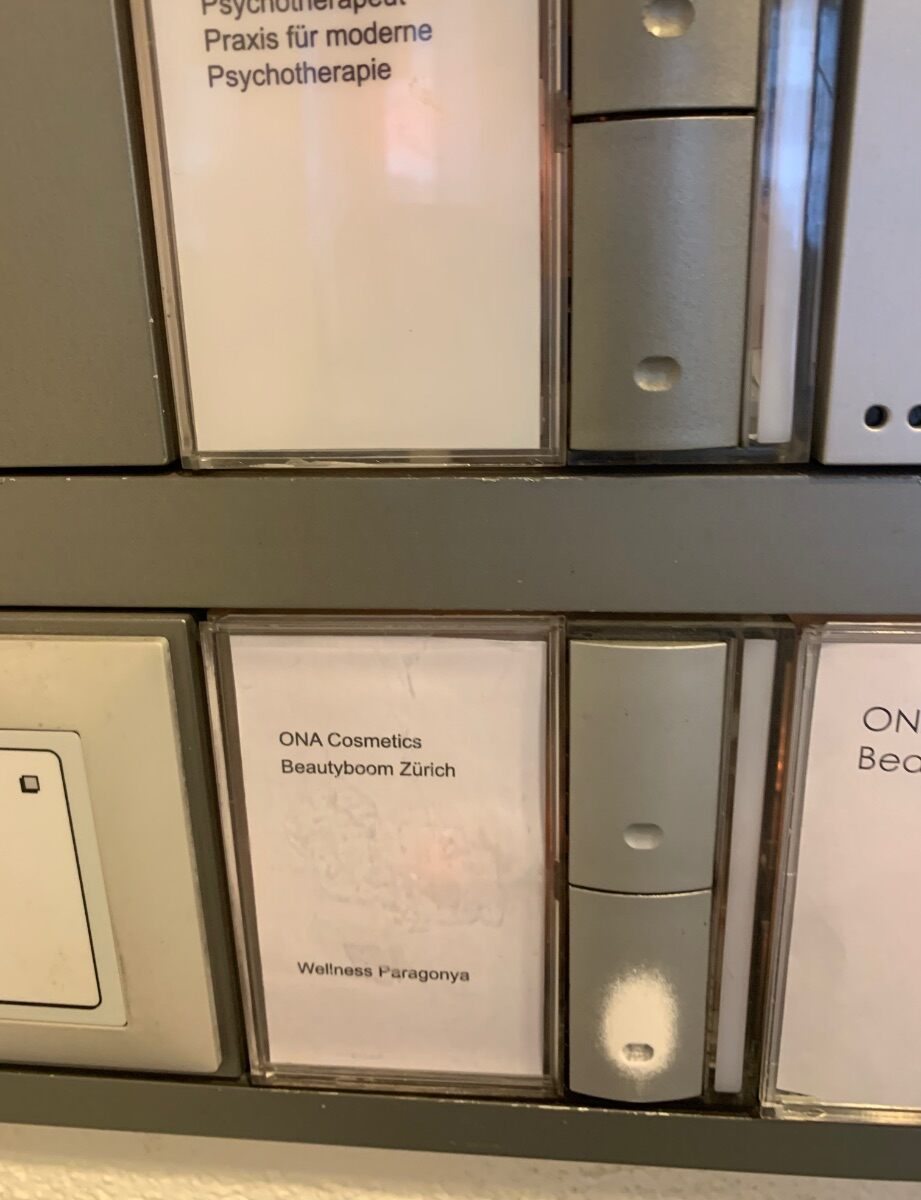
Look for the most warn-down buzzer. LOL
-
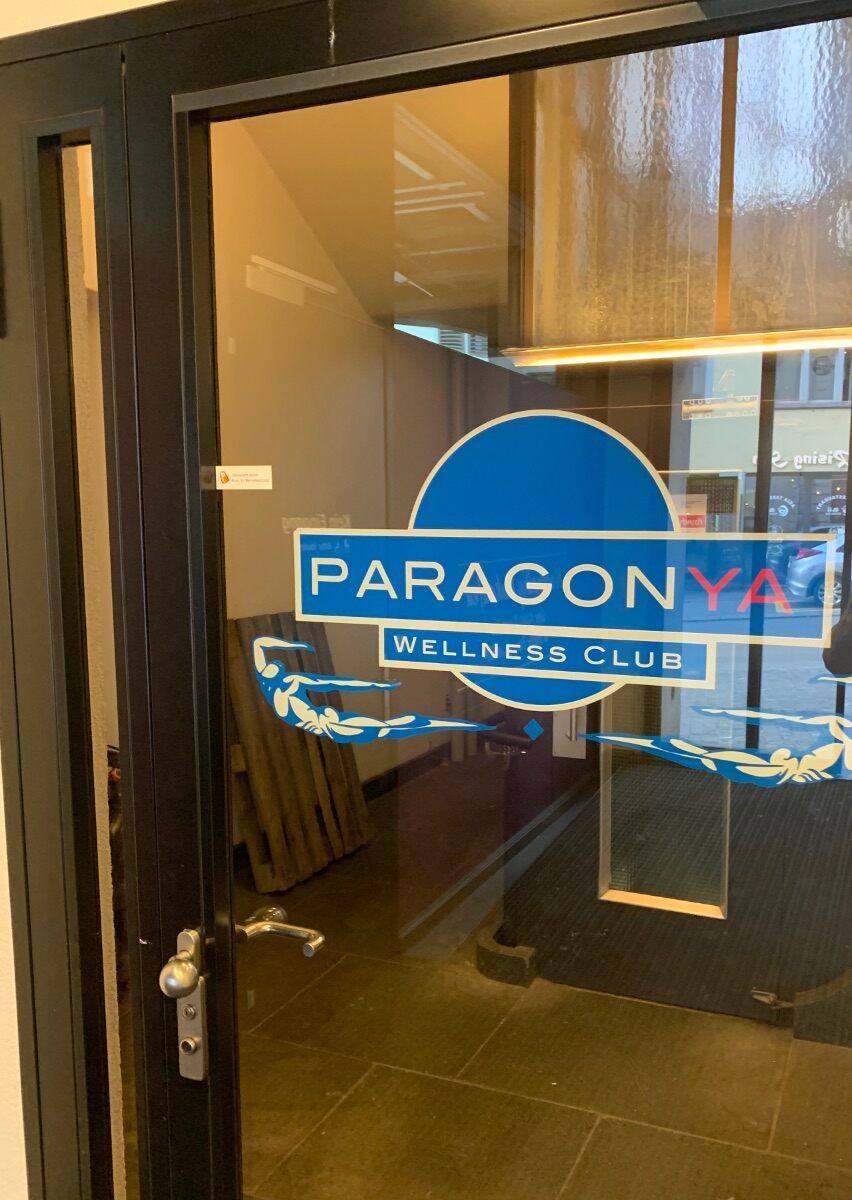
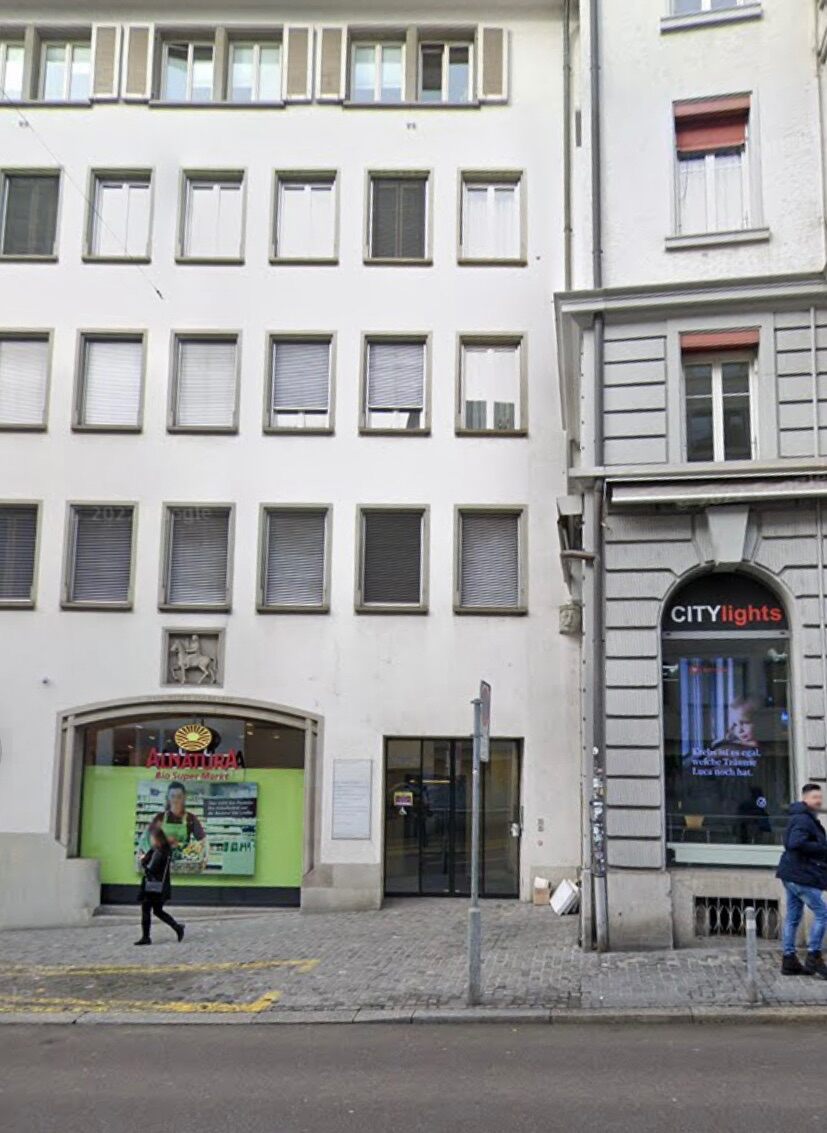
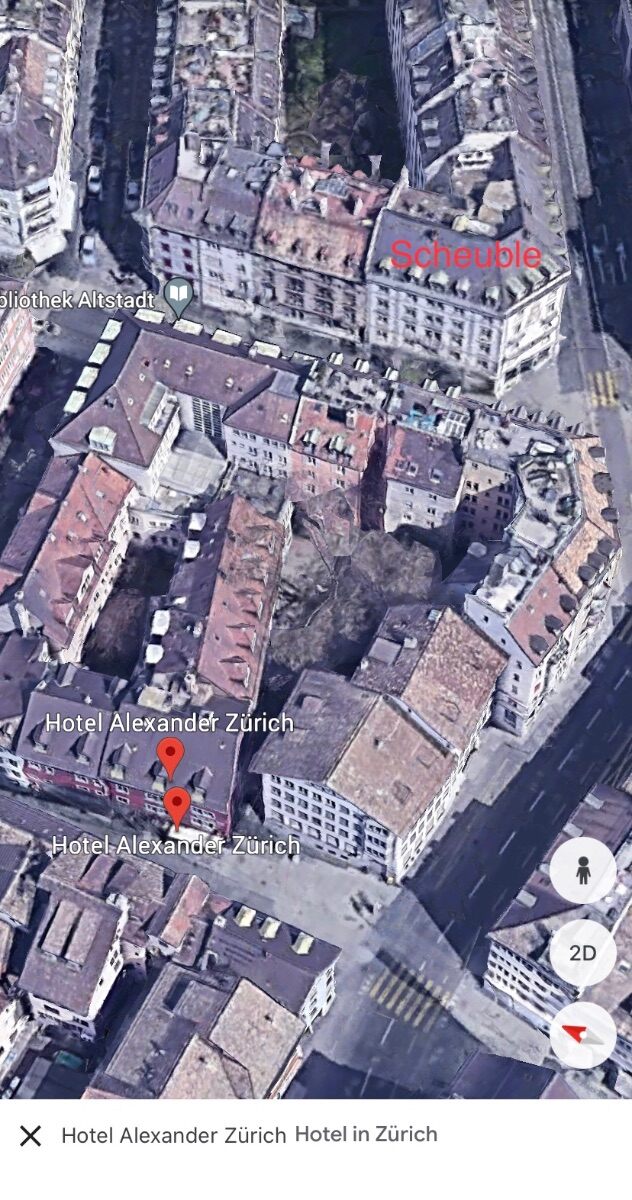
In case of confusion about bearings and reference points the Migros supermarket was replaced with an Alnatura supermarket. Also at 11 Muhlegasse, to it’s right (east) within the small lobby a large Paragonya sign is painted on the inner glass door leading up to the next level, a buzzer with much smaller sign still to the door’s left. I don’t think the useful splashy logo existed a few years ago.
-
…